Innovative Garden Products, Tailored for Your Brand

QINGDAO, China — October 2026 — When a garden hose fails, it usually fails at the fitting: a joint that weeps at the tap, a coupling that pulls off the hose, a connection cross-threaded on the first day of the season. The two decisions that prevent most of it are made before the order ships — which thread, and which material. Qingdao Wanbang Huasheng Trading Co., Ltd. answers the questions its sales team is asked most often about the High Durability Anti-Aging Heavy Duty Garden Water Pipe and the rest of the garden hose range: the problem first, then the specification that solves it.
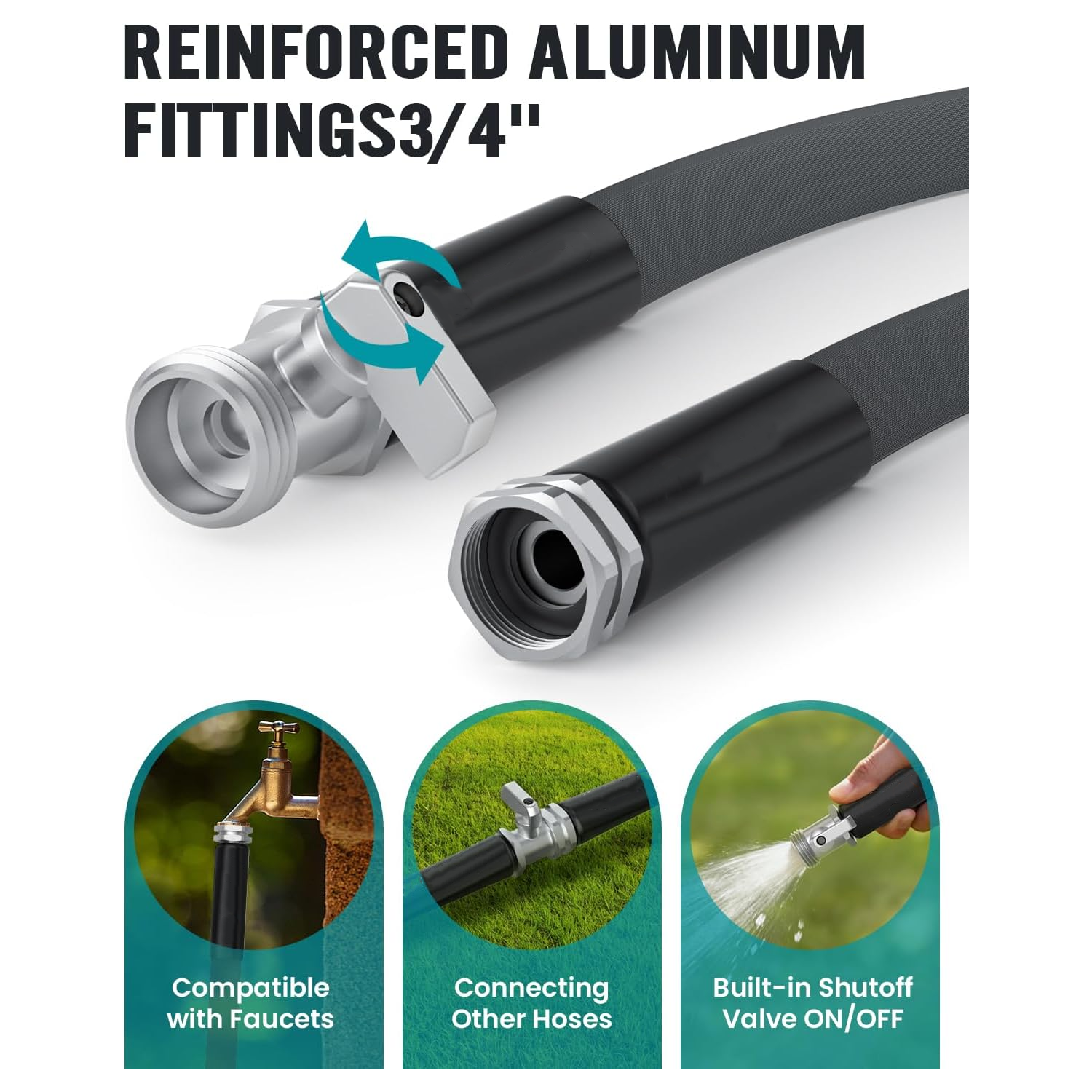
In July 2025 the U.S. Consumer Product Safety Commission announced a recall covering about 3.6 million 5/8-inch expandable garden hoses sold between January 2021 and April 2025. The commission had recorded at least 222 reports of hoses bursting, and 29 injuries — one bone bruise, two sprains, and five reports of temporarily impaired hearing from the sound of the burst. The failure mode named in the notice was not the hose body. It was the interior plastic strain relief, which could break or become fully unthreaded.
That detail is the point. A garden hose is a system of three things — the tube, the reinforcement and the two ends — and the ends are where the load concentrates every time the hose is pulled, coiled and connected. A recall of millions of units turns a specification argument into a commercial one: the fitting is not an accessory, and the material is not a detail.
The questions below are the ones buyers ask when they are choosing a specification rather than a price.
The buyer's problem | Our solution | The specification behind it |
It weeps at the tap connection | Match the thread to the market, and specify the washer with it | GHT 3/4 in, 11.5 TPI, straight thread, washer seal; BSP (BSPP parallel / BSPT tapered) |
The coupling pulls off the hose end | Treat the strain relief as a specified part, not an accessory | Fitting matched to the bore and to the load at the joint |
Brass or plastic — we don't know which to buy | Choose by how often it is connected and what it has to survive | Brass or plastic fittings, both supplied |
The hose kinks and the flow stops | Multi-layer PVC with yarn reinforcement, plus a reel or guide at the corner | Multiple-layer PVC construction with yarn reinforcement |
We don't know which material to stock | Choose by handling, sunlight and storage, not by price per metre | Reinforced PVC / SUS 304 stainless over PVC / expandable |
Can we call it drinking-water safe? | Specify the food-grade compound — and only claim what can be evidenced | Standard compound not certified; food-grade on request |
We need custom lengths, colours and packaging | OEM and retail-ready packaging, quoted case by case | MOQ 1,000 m; blister pack / display box to be discussed |
Solution: the joint is where two different specifications meet, and most leaks there are a mismatch rather than a worn hose. Garden hose thread (GHT) is a straight, parallel thread — 3/4 inch nominal, 11.5 threads per inch — and it seals on a rubber washer, not on the thread itself. National Pipe Taper (NPT) is a tapered thread that seals by thread interference. They are not interchangeable: a GHT fitting forced onto an NPT outlet can go on and still weep, and the thread is damaged in the process. The fix is unglamorous and effective — specify the thread that matches the outlet, and specify the washer with it.
Solution: specify by destination market, not by what happens to be in stock. GHT is the garden hose thread of the United States and Canada. British Standard Pipe is the family used in the United Kingdom, much of Europe and many Commonwealth markets, and it comes in two forms — BSPP (parallel) and BSPT (tapered) — which do not substitute for each other. Our garden hose range is supplied with standard 1/2 inch BSP or 3/4 inch GHT fittings, in brass or plastic, so the same hose can be built for either market. Tell us the country and the outlet and we will specify the end to match; ask for an adapter at the order, not at the complaint.
Solution: brass buys a thread that survives being connected and disconnected, and a coupling that does not deform when the hose is pulled. It suits hoses that are handled daily, left connected under pressure, or used commercially. Plastic is lighter and cheaper, and for a hose that is connected once and left for the season it is a rational choice. The point that matters more than either: the load at the hose end is carried by the strain relief, and a weak strain relief is what turns a leak into a burst. Specify the fitting as a part, not as an accessory.
Solution: choose by how the hose is handled and stored, not by price per metre. The standard PVC garden hose is built in layers — a flexible PVC lining tube, a high-tensile synthetic textile reinforcement, and a weather- and chemical-resistant PVC outer cover — rated from -5°C to +60°C (23°F to 140°F), in 1/2 inch and 5/8 inch bores and 15 m, 25 m and 50 m lengths. The stainless steel garden hose puts a SUS 304 outer hose over a PVC inner hose: corrosion-resistant, and both layers are recyclable materials. A non-expanding reinforced hose holds its length under pressure and resists abrasion and twisting. An expandable hose expands under water pressure and retracts for compact storage. All four do a job; the failure is buying the cheapest one for the wrong job.
Solution: usually both, and both are fixable. Multiple-layer PVC construction with yarn reinforcement is what reduces kinking — it is the reason a reinforced hose behaves better than a single-wall tube — but it does not eliminate it: extreme bends and sharp corners will still cause a temporary kink. So the specification question becomes the fittings and the routing: a swivel connection that lets the hose hang instead of bending at the outlet, a reel or guide at the corner, and a bore that suits the run. If a hose kinks in the same place every season, that place is telling you where the guide belongs.
Solution: drain it, coil it, shade it. After each use, drain the water out and store the hose in a cool, dry place away from direct sunlight. Check it periodically for cracks and leaks, and repair or replace damaged sections rather than running them. The rated range of -5°C to +60°C (23°F to 140°F) describes performance, and the published performance data is referenced to 20°C — temperature changes the numbers, so a hose left in direct sun or drained and frozen is outside the conditions the rating describes. Storage is not a marketing point; it is the difference between a three-season hose and a one-season hose.
Solution: only if the compound is specified for it — and only if you can evidence the claim. The standard garden hose PVC compound is not certified for potable water. If drinking-water safety is required, the food-grade or potable-water-compliant PVC compound has to be specified at the order; it is a different material, not a label. Two things follow. The fitting is part of what touches the water, so the brass or plastic has to be declared as well, not just the tube. And in the EU, Directive (EU) 2020/2184 requires materials in contact with drinking water to be covered by European positive lists, so a potable claim moves the compound and the fitting into a regulated regime. We will tell you what the compound is; we will not describe a standard hose as potable.
Solution: tell us the outlet at both ends and we will confirm what we can build, rather than assume it. The range is supplied with 1/2 inch BSP or 3/4 inch GHT fittings in brass or plastic, and custom lengths and colours are available for OEM and retail packaging orders. What we will not do is guess: a mixed-thread assembly is a specification decision, and if it is not something we can build as standard we will say so before the order rather than after the return.
Solution: 1,000 metres is the standard wholesale MOQ. Custom lengths and colours are available for OEM and retail packaging orders, and retail-ready packaging — blister pack or display box — is quoted case by case with our sales team rather than assumed. Send the market, the thread, the bore, the length and the packaging you sell, and we will come back with a specification sheet you can check line by line.
Specifications, fitting options and the enquiry form are on the product page: High Durability Anti-Aging Heavy Duty Garden Water Pipe. Send us the outlet, the market and the job, and we will specify the thread and the material that fit it.
Qingdao Wanbang Huasheng Trading Co., Ltd. supplies PVC garden hose, layflat hose and related water transfer products to distributors, brand owners and contractors, with OEM/ODM support for custom lengths, colours and packaging.

 English
 Español
 Русский
 Français
 Deutsch
 简体中文
 Árabe
 Português
 日本語
 한국어
 हिंदी
 Prancis
 Türkçe
 Tiếng Việt
 Italiano
 ไทย

