Innovative Garden Products, Tailored for Your Brand

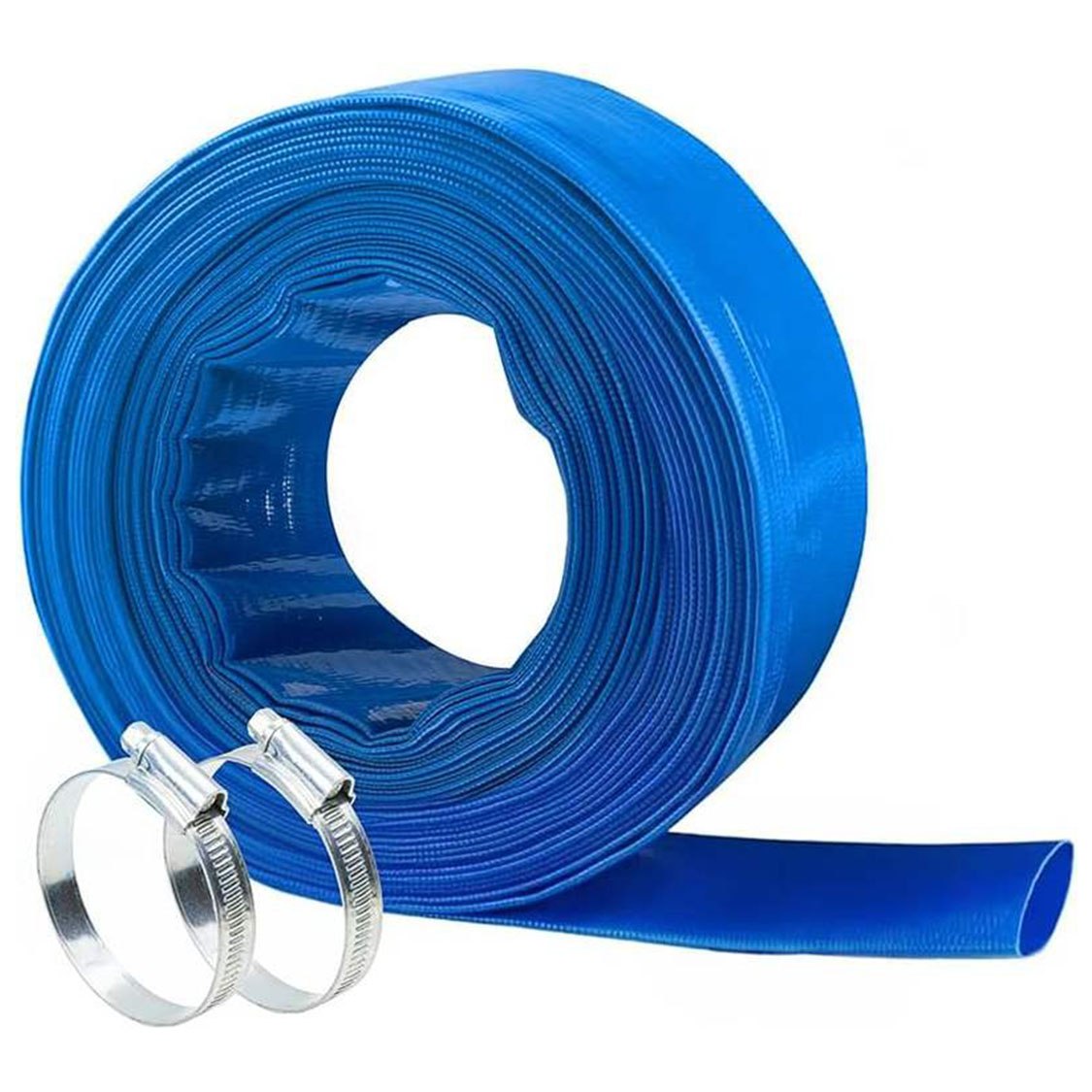
QINGDAO, China — October 2026 — The questions buyers bring to a layflat hose supplier are rarely about the hose. They are about a problem: a line that failed mid-season, a coupling that gave out before the hose did, a pump that cannot push water down the run, a hose that will not uncoil on a cold morning, a water bill that keeps climbing. Qingdao Wanbang Huasheng Trading Co., Ltd. collected the questions its sales team is asked most often about the PVC Layflat Hose and answers them the way buyers ask them — the problem first, then the specification that solves it.
The European Commission's water resilience strategy sets out the EU's objectives on water: to restore and protect the water cycle, to build a water-smart economy, and to secure access to clean and affordable water. Two of its stated commitments bear directly on irrigation and discharge equipment — guidance to reduce water consumption and improve water efficiency in the EU by 10% by 2030, and action to reduce leaks in pipes and modernise water infrastructure. The Commission also notes that by 2030 global water demand is expected to exceed available resources by 40%.
For agriculture the same agenda has been moving from policy into practice. The EU CAP Network conference “Water resilience in agriculture: innovation in practice”, held in Hamburg, Germany from 19 to 21 May 2026, set aside one of its six thematic clusters for digital tools, irrigation efficiency and precision irrigation, with the programme built around drought, flood and water quality challenges. Its framing was consistent: water has to travel further, with less loss, on equipment that lasts.
None of that changes the physics of a hose, but it does change what a failure costs. Bore and working pressure still trade off against each other, the reinforcement layer still decides what the line can take, and the cover still decides how long it survives on gravel. What has changed is that a hose specified for the wrong duty cycle is no longer just a consumable — it is a leak that repeats every season, and a line item that comes back every budget cycle. The nine questions below are the ones buyers ask, each followed by the specification that answers it.
Solution first: in most cases the hose was not specified for the duty it was given. Three things decide whether a layflat hose survives a season — the grade, the working pressure and the cover. On this range each size is rated with a burst pressure of at least three times its working pressure, and working pressure falls as the bore grows, so the largest diameters carry the lowest ratings and the smallest diameters the highest. Rated values across the standard, medium duty and heavy duty grades span roughly 30 PSI to 150 PSI, with the heavy duty grade rated up to 160 PSI in the smaller sizes. Specify for the highest pressure the line will actually see, including surge from pump start-up, not for the average — and check the outer cover against what the hose is dragged over, because the cover is what decides how long it lives on gravel and concrete.
Solution: match the grade to the duty cycle, and the arithmetic usually changes. The standard grade suits intermittent discharge, where the hose is laid out, used and rolled up. The medium duty discharge hose uses a thicker PVC tube wall and higher-tenacity polyester yarn reinforcement, which raises working pressure and extends service life under continuous pumping. The heavy duty layflat water hose uses multi-layer polyester reinforcement for mining dewatering, high-pressure irrigation and industrial fluid transfer, where burst pressure and abrasion resistance matter most; those hoses are pressure tested before shipment. One hose that lasts the season is normally cheaper than two cheap ones plus the downtime — and the labour and disruption of a mid-season failure rarely appear on the quotation.
Solution: work backwards from the pump and the run, not from the price list. Between 1 inch (25 mm) and 16 inches (408 mm) is available across the range; the medium duty line runs from 1 inch to 6 inches (25–150 mm) and the heavy duty line from 1.5 inches to 10 inches (40–250 mm). Two rules matter. On this range bore and working pressure work against each other, so a bigger bore means a lower rated pressure for the same grade. And the diameter has to match the pump and the length of the run. Give us the pump, the flow you need and the distance the water has to travel, and we will advise on the size before the order — it is cheaper than discovering it in the field.
Solution: yes — specify hose and couplings together instead of sourcing them separately. Layflat hose is normally coupled with camlock fittings (Type C or Type E), aluminium STORZ couplings, or standard threaded hose fittings, supplied in aluminium, stainless steel or polypropylene. The coupling has to be matched to both the hose bore and the pressure rating of the line, and that is where mismatched purchases usually fail: the fitting is bought for the thread, not for the pressure. We supply matched couplings with the hose so the assembly is rated as one item.
Solution: treat the hose as part of the water-efficiency question rather than a consumable. The European Commission's water resilience strategy asks the EU to reduce water consumption and improve water efficiency by 10% by 2030 and to reduce leaks in pipes and modernise water infrastructure. At the hose, that means four practical things: specify the grade so the line does not fail and leak repeatedly mid-season; match the bore so the pump is not working against the line; keep the run as short as the job allows; and store the hose flat, drained and out of direct sun so the following season starts from a sound hose rather than a replacement. None of that replaces the pipe network — but a discharge hose that fails every season is a leak that repeats every season.
Solution: the medium duty hose is compatible with commonly used agricultural fertilisers and mild pesticide solutions diluted in water, so one line can do both jobs. Two limits apply. Concentrated chemicals and solvents should not be run through it. And although the inner PVC lining stays chemically inert when carrying clean water, irrigation water or mild agricultural chemicals, this is not a chemical transfer hose and should not be specified as one — if your application is chemical dosing rather than irrigation, tell us and we will say plainly whether the hose suits it.
Solution: it depends on how the hose is handled, not on the temperature alone. Our TPU layflat hose is specified for abrasion resistance, flexibility at low temperatures and longer service life than the PVC grades. If the hose is dragged over rock, gravel or concrete, or if it has to stay workable in cold conditions, TPU is the grade that pays for itself. For temporary irrigation, flood response and general discharge, the PVC grades are the lower-cost choice and are the ones most buyers order. If you describe the ground and the working temperature, we will tell you which of the two actually solves it.
Solution: we will tell you what we can evidence rather than what sounds good. Fire-fighting layflat hose is a regulated category: EN 14540 covers non-percolating layflat hoses for fixed fire-fighting systems, at a maximum working pressure of 1.5 MPa in inside diameters from 25 mm to 52 mm, and BS 6391 specifies non-percolating layflat delivery hoses. Our heavy duty layflat hose is built for high-pressure water transfer, including fire-fighting water supply. If your project requires certified fire hose, tell us the standard and the certification you need on the purchase order, and we will confirm against that specification before you commit.
Solution: the standard MOQ is 1,000 metres per product specification, and mixed sizes within the same product line can be combined to reach it, so you do not have to commit 1,000 metres to a single diameter. Standard lead time is 25–30 days after order confirmation and deposit receipt, and urgent orders may be available from stock. Custom colours, branded packaging and custom length coiling are available, and matched couplings can be supplied with the hose. Send us the sizes and the packaging you sell and we will confirm the configuration, the MOQ and the schedule against it.
Qingdao Wanbang Huasheng Trading Co., Ltd. supplies PVC layflat hose, garden hose and related water transfer products to distributors, brand owners and contractors. The layflat range covers three duty grades — standard, medium duty and heavy duty — with OEM/ODM support for custom sizes, colours and packaging.

 English
 Español
 Русский
 Français
 Deutsch
 简体中文
 Árabe
 Português
 日本語
 한국어
 हिंदी
 Prancis
 Türkçe
 Tiếng Việt
 Italiano
 ไทย

